This article first appeared in Traction Magazine when it was a quality read under David Brown’s editorship.
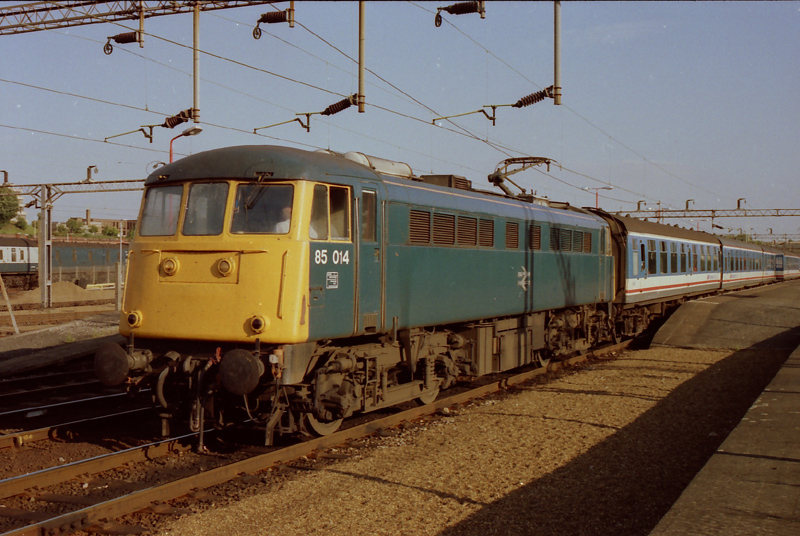
To most observers the reporting numbers 1B06, 1B07, 1B08, 1B09 and 1B10 meant little. They were the Evening Cobblers, nine‑ to 13‑coach Mk.I formations running fast between Euston and Northampton. They were shunned by most bashers as low‑mileage turns and overlooked by the railway press as low‑interest workings, yet they became essential trains for some of the more desperate locals!
The full four‑train loco‑hauled service began 17 May 1982, initially as a Monday‑to‑Friday peak‑hour measure to overcome slow‑line track problems. An evening Birmingham–Euston via Northampton working added further variety, and from May 1986 a Saturday Cobbler appeared as well.
They were big trains of conventional stock, tightly timed and usually entrusted to ‘Roarer’ power [Classes 81-5]. For many they became unforgettable workings, and it was a sombre evening when the last Cobbler ran north from Euston some nine years later May in 1990.
Before May 1982 the Evening Cobblers consisted of two loco‑hauled peak‑hour services. A 1B06, the 17:14 Euston–Northampton had run for many years with a single stop at Bletchley and was a solid Roarer turn until May 1984. In the late 1970s it regularly produced Classes 82, 83 and 84 as well as 81s and 85s. Another service, 1B08, the 17:45 Euston–Northampton was introduced in January 1980 to meet growing commuter demand and called at Leighton Buzzard only.
From May 1982 the loco‑hauled Cobbler service expanded to four trains, a pattern that remained in place for nine years. Other workings formed part of the wider sequence.
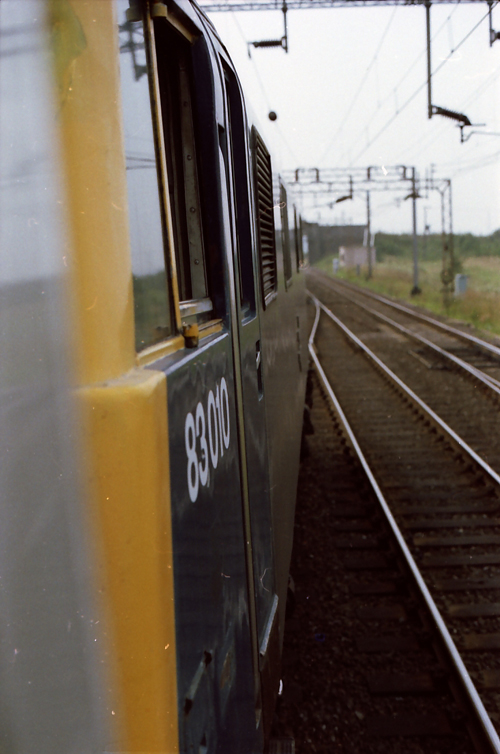
83010 on 1B07 crosses from the down fast to down slow at the old Ledburn Jn on August 6th 1982.
Although not a Cobbler, 1A76 the 17:30 Birmingham–Euston formed part of the evening scene and was normally a short half‑rake of four or five Mk.Is. It called at all unit stations, including Northampton, Wolverton, Milton Keynes, Bletchley and Leighton Buzzard. It was loco‑hauled from May 1983 to 1985, reverting to a unit thereafter.
The Saturday Cobblers also ran with short rakes and regularly achieved 100 mph‑plus running.
Another service was 1B10, the 19:35 Euston–Northampton which called at Leighton Buzzard, Bletchley and Milton Keynes. It generally used the stock off 1B07, which terminated at Bletchley and returned empty to Euston when 1B10 ran. This arrangement applied from May 1986 to May 1988 and again from May 1989 onwards.
From May 1988 the trains were recoded into the INXX series, and by then the traction had become increasingly routine.
Throughout their existence the Evening Cobblers benefited from a power situation at Euston that was often stretched. Diagrams varied from year to year but could be loosely summarised as follows:
- 1B06 generally produced Classes 81–85;
- 1B07 usually produced a Class 86/3 or 86/4
- 1B08 tended to be a Class 86/2
- 1B09 again a Class 86/3 or 86/4
- 1B10 generally produced Classes 81–85
For several years the locomotive off 1B06 went forward on vans, while the 86s off 1B07 and 1B09 would work in multiple on liners from Rugby to Willesden. The 1B08 locomotive returned empty to Euston Car Shed, and the 1B10 Roarer also finished up on vans. Diagrams for the AC electrics were fluid, and the vacuum‑braked stock was probably the main factor in power allocation. Even with sectorisation, the unpredictability of traction on the Evening Cobblers remained.
When power was particularly tight, especially on Fridays, additional locomotives were required for Fridays‑only traffic. This brought Class 86/0s and later 86/5s into rare daytime departures from Euston on Evening Cobbler duties. Other classic kick‑outs caused by severe shortages occurred from time to time.
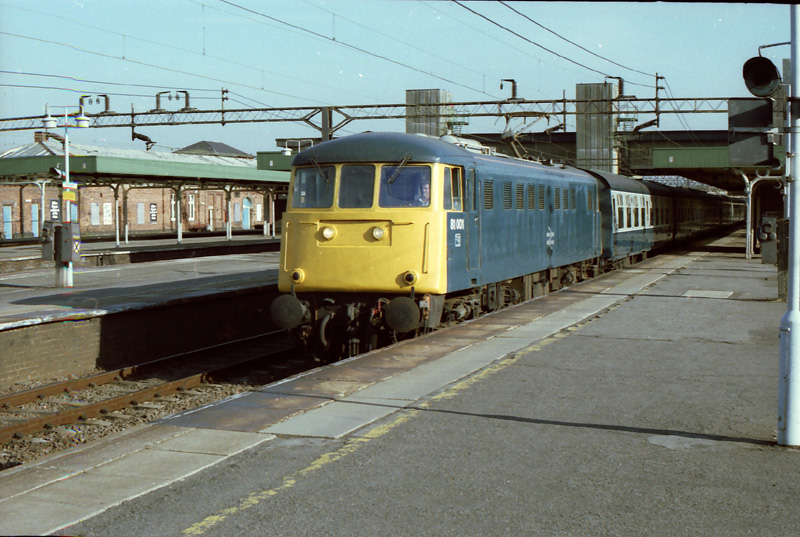
A superb image from the late Tony Ewer of 81001 arriving at Bletchley with 1B08 on July 29th 1983, sadly this fine machine would be destroyed by fire the following month
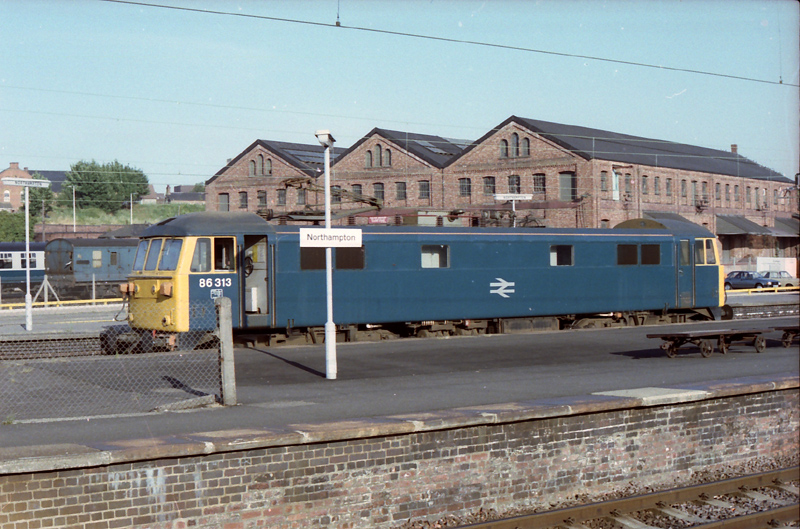
The late Tony Ewer catches 86313 at Northampton after she had worked 1B09 earlier on July 29th 1983
Solid nights of Roarers on all four diagrams continued on occasions until November 1988, and Roarers on the majority of trains still appeared intermittently until November 1989. From November 1989 to May 1990, Class 86/2s and 86/4s dominated, with only the occasional Roarer. Just a week before the final working, on 4 May 1990, 85037 appeared on 1B07 after completing several weeks of ATP test work.
Roarers were the traction we were after, and over the nine years of Evening Cobbler operation more than 2,500 recorded Roarer workings were available to choose from.
All Cobbler rakes were generally vacuum‑braked Mk.Is, running in sets of ten to 13 coaches, depending on availability. The 1B06 and 1B07 formations were normally TSOs. In its early years 1B08 was a Euston–Blackpool rake of Mk.IIe vehicles, including a non‑operative Mk.I buffet. As these were air‑braked vehicles, the services occasionally produced a Class 87. After reverting to Mk.Is, 1B08 became composite stock for many years. Over time all formations became open stock, apart from a few BSKs, and liveries changed from blue/grey to Network SouthEast blue and red in the late 1980s. Repainting usually coincided with quality refurbishment and the fitting of dual braking.
Exceptions to Mk.I stock were rare and were largely eliminated with sectorisation, though Mk.IIa, Mk.IIe and even Mk.III vehicles all made occasional Cobbler appearances. The rakes also saw use on many railtours, the most notable being FIRT’s Tubular Belle in April 1988.
Crowds of bashers were unknown on these trains; sombre commuters filled the Evening Cobblers. The last departure, 1B10, tended to have a livelier drinkers’ atmosphere. Whatever the train, a Roarer on a heavy load at 100mph created its own unmistakable mood.
Despite a maximum of five trains operating solely in the evening peak, and with only a few intermediate stops, several workable moves were possible even for non‑commuters.
In 1982 my moves were dictated by the then‑necessary question of whether the locomotive was required for haulage. Bus‑stop moves between Leighton Buzzard, Bletchley and the newly opened Milton Keynes Central were standard.
May 1983 brought 1A76, allowing return loco‑hauled mileage from Northampton. My usual move was to take 1B06 forward from Bletchley, as it was a reliable Roarer turn and always reached Northampton with about 20 minutes to spare for 1A76 back. If 1B06 was an 86, then it was a unit to Milton Keynes for 1B07 to Northampton, sometimes a tight connection at both Milton Keynes and Northampton. In those days 1B07 tended to roar [Classes 81-5] when 1B06 was a Can [Class 86].
When 1A76 roared you stayed on as far as funds allowed. If 1A76 was a Can, you endured it to Milton Keynes for a plus‑eight onto 1B09. This was often a man‑of‑steel leap, as 1A76 was nearly always ten minutes late. If 1B09 was already in, there was no chance; if it was just arriving, as it usually was, you had to jump off 1A76, race across the bridge and fight your way against the tide of commuters swarming up the steps — the very steps you needed to be at the bottom of. Five years later we were still battling the same crowds at Milton Keynes.
From May 1987 Roarer workings began to decline, and it became a matter of waiting patiently for the first available Roarer. The fairly solid Roarer diagram on 1B10 was a welcome constant. Travelling up to Euston to view the Evening Cobblers gave the bonus of extra mileage and the chance to see 1B06 and 1B09 in the coach sidings and carriage shed respectively, with the stock for the other trains hauled in. With Euston’s usual desperate power situation, predicting that evening’s traction was often difficult.
From May 1988, as Roarer workings fell to one or two each evening at most, the move became simply to take the first available Roarer throughout. As the number of evenings with no Roarers increased, it became a demoralising routine standing at Euston watching a procession of Class 86s leave for Northampton while the solitary 81 or 85 went out on empty stock for Wembley Yard.
Anyone who regularly followed the same trains knew that occasional incidents were inevitable. The more often you did them, the more frequent the event, farce or riot. These were my own favourites, a small selection from many.
On 25 November 1982 a work‑stained 83012 worked 1B09, probably its final passenger turn and certainly the last recorded Class 83‑hauled Evening Cobbler. It was stored unserviceable on 28 November and reinstated six months later as a very restricted Euston empty‑stock locomotive. A really notable working was 31263 working
1A76 throughout on 13 October 1983.
On 20 December 1983 came one of the best nights of all. A northbound liner had brought down the wires on a large scale in the early hours, and with a neutral section also damaged there was no overhead power on any track between Hemel Hempstead and Berkhamsted for more than 24 hours. I joined an Aylesbury‑based eight‑car DMU forward from Tring on an afternoon shuttle. An ex‑St Pancras set (51607/51640/51624/51610) had been dug out of stored status and assisted, along with the more regular Tyseley sets. The evening loco‑hauled rush hour from Euston showed the massive effort made to maintain a service that winter’s night. Other notable trains included: 25213 with ten Mk.Is was on the 16:00 Euston–Bletchley additional, 25175 on the 16:15 Euston–Northampton additional, dragging dead 310078 and 310093. The packed 310s had little lighting; the guard rang the bell for right‑away, the 310 driver sounded his horn, the Rat’s driver acknowledged the tip and we stormed up Camden Bank. 47314 on the 16:45 Euston–Glasgow, dragging an 87. 25192 on the 17:14 Euston–Northampton (load eleven Mk 1s). 47321 on a Euston–Northampton additional (load ten Mk 1s). 47011 on a Euston–Glasgow additional, dragging 86254. 25287 on a Euston–Northampton additional, dragging two Class 310s. 25251 on a Euston–Rugby additional (load ten Mk 1s). By 19:30 DMUs took over Euston–Hemel shuttles with buses forward to Tring. They also dragged overnight and early‑morning services the next day, with Class 25s doing most of the work. It is hard to imagine what a similar incident would produce today. [probably nothing but a swath of cancelations – Editor]
On 19 April 1985, 86432 became the first 86/4 to work an Evening Cobbler. For us it was a shame it was not the last. On 23 April 1985, 85030, already 30 minutes late on 1B07, arrived at Leighton Buzzard on the Down slow platform and failed completely. The Down Fast wires had been brought down south of Bletchley, giving a complete northbound blockage. 86222 on the 17:30 Euston–Glasgow gave rear‑end assistance to Bletchley, where 31203 was attached to 1B07 to work through to Northampton.
The Evening Cobblers produced their share of incidents, and anyone who followed them regularly accumulated a catalogue of favourites. These were mine.
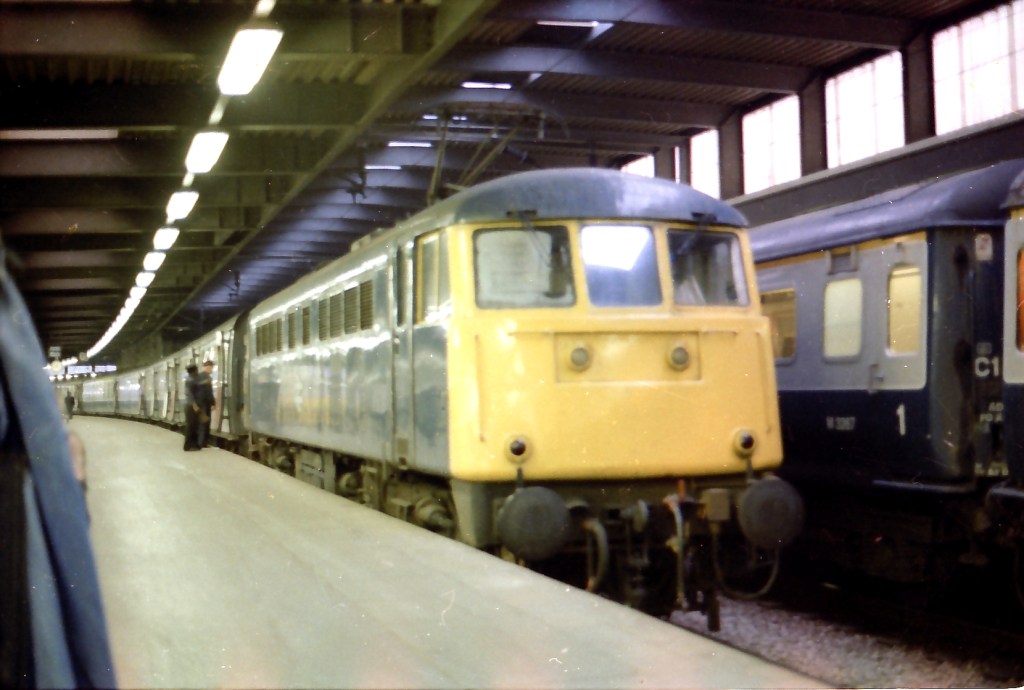
The end of an era, 85011 at the Euston blocks with the last ever 1A76
- 10 May 1985, 85011 worked the final 1A76.
- 22 November 1985, 85040 on 1B09 failed to make its booked stop at Leighton Buzzard, running through at about eighty miles an hour. The cord was pulled two miles north, giving Leighton Buzzard passengers bonus mileage to Bletchley for a unit back.
- 8 September 1986, 86030 worked 1B09, the last Evening Cobbler to be handled by this always uncommon subclass.
- 1 October 1986, 86316 worked 1B10, the final appearance of an always routinely common subclass.
- 24 February 1987, 86401 worked 1B08, one of only a few Cobbler turns it ever handled despite its distinctive NSE livery.
- 17 March 1987 came the first clear sign of the decline in Roarer workings. That evening 86417 worked 1B06; 86404 worked 1B07; 86233 worked 1B08; 86411 worked 1B09; and 86243 worked 1B10.
- 18 March 1987, the following night showed how fluid the power situation could be. 85017 worked 1B06; 85019 worked 1B07; 86218 worked 1B08; 85025 worked 1B09; and 85002 worked 1B10. Whether the same controller was responsible both nights was anyone’s guess.
- 10 June 1987, 85040 on 1B10 failed as we accelerated away from Wolverton. Speed steadily fell to a crawl over the Hanslope Junction–Roade summit. Once over the top we coasted downhill all the way into Northampton.
- 2 November 1987, 81005 on 1B10 failed at Hanslope Junction with a loud crack from inside. We coasted at speed down the bank, but the vacuum brakes dug in hard just before Hunsbury Hill tunnel, bringing us to a stand at milepost 65¼, half a mile short of Northampton. After a long wait and much whistling, 08458 emerged from the fog to haul us into the station.
- 28 May 1987, 85036, one of the less reliable Roarers, failed at Harrow. 31280 assisted throughout, arriving in Northampton an hour late.
- 18 May 1988, 31294 and 31308, turned out due to a desperate power shortage, worked 1B09 throughout. Only fifteen minutes were lost on timings set for 100 mph electrics. At Milton Keynes about twenty commuters alighted and stared at their traction — the first sign of normal interest ever seen.
- 14 October 1988 the new subclass 86501 and 86502 each worked separate Evening Cobblers. By running to right‑time they were cleared for 100 mph on their trips, despite being nominally limited to seventy‑five.
- 8 December 1988, 86410 on 1B06 suffered a smashed windscreen near Wembley North, though the driver was unhurt. We were routed round the failure on 85036 with the following 1B07. 81007 was taken off its Etches Park–Wembley empty‑stock duty and worked forward to Northampton, by then a rare appearance for an 81.
- 21 July 1989, the evening after the Harrow derailment, 85106 became the first of only two recorded Evening Cobbler workings by this uncommon subclass.
- 11 August 1989, 81007 worked 1N51, the last and best Class 81 to handle an Evening Cobbler.
- 14 November 1989 came the last real evening: 85015, 85034, 85101 and 86501 all appeared. These were the final workings of subclasses 85/1 and 86/5 on the Evening Cobblers.
- 4 May 1990, 85037 on 1N51 became the last Roarer to work an Evening Cobbler. Fresh from ATP tests, it provided an enjoyable farewell turn.
- 11 May 1990, 86401 worked the final Cobbler, 1N55. It was an evening for the unusual: commuters talked, drank champagne, and balloons drifted around the front coach. An unusually high turnout of bashers — five — made the last run.
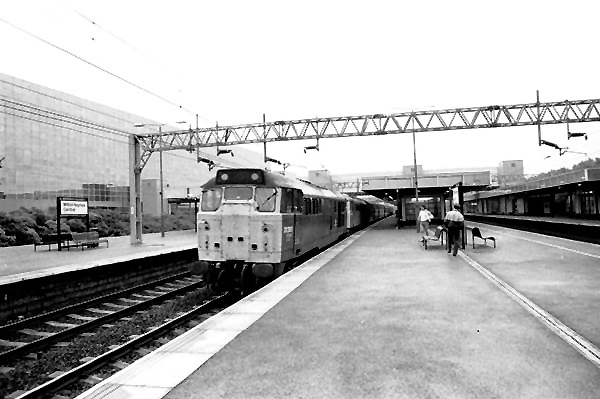
85036 was a famously troublesome “roarer” in that she liked to fail a fair bit. 85036 failed at Harrow on 1B09 Evening Cobbler from Euston to Northampton. On being told their train was caped so the story goes the commuters refused to move. Rescue came from 31280 about 50 down and she took the troublesome roarer and commuters through to Northampton on May 28th 1987. A “Neil Evans” phot
The run‑down
Although introduced in May 1982 as a temporary measure, and surviving rumours of withdrawal with every timetable change, the end did not come until 19 October 1989 when 85011 worked the final 1N57 (1B10), the 18:53 Euston–Northampton. An eight‑car Class 321 provided a dull replacement.
Enjoying the thrash behind 85011 on an Evening Cobbler on 15 January 1990, I was surprised to read in a magazine that the Cobblers would be gone “by the time you read this”. “Cobblers” seemed an appropriate response. There was some truth in it, though, as 19 January 1990 saw the last 1N47, the 16:43 Euston–Northampton. After that only four loco‑hauled trains remained, lasting until 16 March 1990 with the final 1N49 (1B06), the 17:14 Euston–Northampton, and 1N53 (1B08), the 17:44 Euston–Northampton. Then only two loco‑hauled evening services survived: 1N51 (1B07), the 17:22 Euston–Bletchley, and 1N55 (1B09), the 18:14 Euston–Northampton. These remained until the last day.
| Example Workings of the “Cobbler” Services in its Final Months | |||
| Friday 2 February | |||
| 86212 | 1N51 | 17:22 | London Euston – Northampton |
| 86401 | 1N53 | 17:14 | London Euston – Northampton |
| 86430 | 1N55 | 18:14 | London Euston – Northampton |
| Monday 19 February | |||
| 86229 | 1N14 | 17:14 | London Euston – Northampton |
| 86438 | 1N53 | 17:44 | London Euston – Northampton |
| 86241 | 1N55 | 18:14 | London Euston – Northampton |
| Wednesday 21 February | |||
| 85003 | 1N46 | 06:57 | Northampton – Euston |
| Friday 23 February | |||
| 85007 | 1N46 | 06:57 | Northampton – Euston |
| Monday 26 February | |||
| 86248 | 1N55 | 18:14 | London Euston – Northampton |
| Tuesday 27 February | |||
| 86248 | 1N55 | 18:14 | London Euston – Northampton |
| Friday 2 March | |||
| 85011 | 1N55 | 18:14 | London Euston – Northampton |
| Thursday 8 March | |||
| 86231 | 1N14 | 17:14 | London Euston – Northampton |
| 86423 | 1N53 | 17:44 | London Euston – Northampton |
| Monday 12 March | |||
| 86248 | 1N55 | 18:14 | London Euston – Northampton |
| 86411 | 1N14 | 17:14 | London Euston – Northampton |
| 86414 | 1N53 | 17:44 | London Euston – Northampton |
| Tuesday 13 March | |||
| 85011 | 1N48 | 07:16 | Northampton – Euston |
| Wednesday 14 March | |||
| 85040 | 06:57 | Northampton – Euston | |
| Friday 16 March | |||
| 85030 | 1N48 | 07:16 | Northampton – Euston |
| Friday 23 March | |||
| 85018 | 1N55 | 18:14 | London Euston – Northampton |
| Tuesday 27 March | |||
| 86206 | 1N54 | 07:37 | Northampton – Euston |
| Tuesday 29 March | |||
| 86419 | 1N55 | 18:14 | London Euston – Northampton |
| Monday 2 April | |||
| 86431 | 1N55 | 18:14 | London Euston – Northampton |
| Thursday 12 April | |||
| 86212 | 1N55 | 18:14 | London Euston – Northampton |
| Friday 4 May | |||
| 86240 | 1N55 | 18:14 | London Euston – Northampton |
| Wednesday 9 May | |||
| 86240 | 1N53 | 17:44 | London Euston – Northampton |
| Thursday 10 May | |||
| 86406 | 1N55 | 18:14 | London Euston – Northampton |
| Friday 11 May | |||
| 86401 | 1N54 | 07:37 | Northampton – Euston |
| 86401 (replaced 86406) | 1N55 | 18:14 | London Euston – Northampton |
Rumours had circulated for months, but Friday 11 May 1990 was finally confirmed as the last day of the Cobbler. On that final day we headed north on the 06:24 and got off the Class 321 at Bletchley, which let us confirm that 86233 was indeed working the final Bletchley Cobbler. It also gave us three extra miles on the 07:14 Bletchley–Stoke Class 310, a Class 1 working that always delivered.
The big yellow TV platform monitor screen at the Keynes read as below, a nice touch by Bletchley PSB.
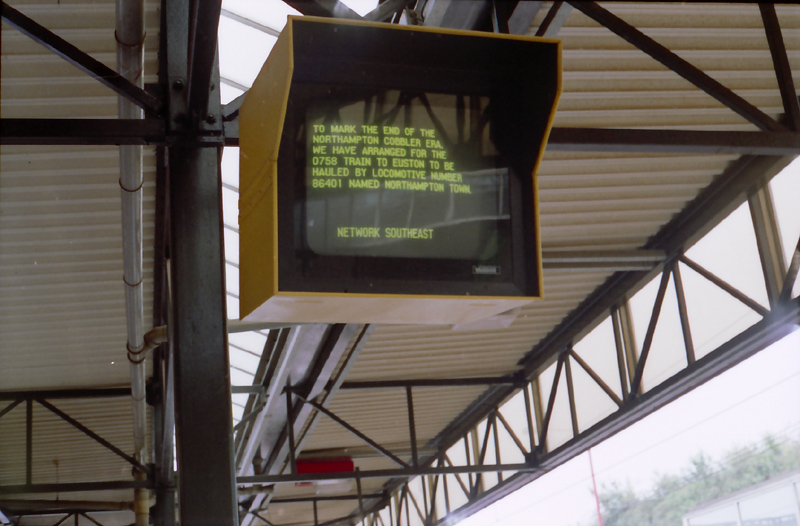
“To mark the end of the Northampton Cobbler era we have arranged for the 07:58 train to Euston to be hauled by locomotive number 86401 named Northampton Town”
Over the course of the day I did the following moves,
| My Bashing Moves on Friday 11 May 1990 | |||
| Traction | Time | Service | Move |
| 321442 | 05:26 | Euston to Wolverhampton | LB-BY |
| 310108 | 07:14 | Bletchley-Stoke | BY-MK |
| 86401 | 07:37 | Northampton to Euston (the last 1N54) | MK-EU |
| 310087, 310092 & 310085 | 10:00 | Fenchurch St to Shoeburyness | FS-SH |
| 310088 | 11:26 | Shoeburyness to Fenchurch St | SH-PI |
| 302206 | 11:50 | Southend to Fenchurch St | PI-FS |
| 310077 & 310047 | 15:32 | Liverpool St to Cambridge | LS-BS |
| 310064 & 310069 | 16:20 | Bishops Stortford to Liverpool St | BS-LS |
| 86401 (replaced 86406) | 18:14 | Euston to Northampton (the last 1N55) | EU-MK |
| 85003 | 19:03 | Euston to Manchester | MK-CR |
| 37221 | 2010 | Manchester to Cardiff | CR-SH |
| 150167 | 22:30 | Shrewsbury to Birmingham | SH-NS |
| Saturday 12 May 1990 | |||
| 321401 | 00:15 | Birmingham-Euston | NS-LB |
In the evening at Euston both Cobbler rakes stood side by side on platforms 5 and 6 for the last time. A fill‑in move then sent the four of us east towards unfamiliar Fenchurch Street. As the day unfolded, we enjoyed a lively run on former Birmingham Class 310s in their latest territory, and with gen from Bletchley PSB’s finest we managed a 12‑car set — half the fleet — plus a few more 310s out of Liverpool Street.
The final 17:22 to Bletchley was flagged away with 86233 leading. 85011 stood opposite on platform 15, but attempts by my colleagues to persuade the traction arranger that “85011 was much better than 86233 on 1N51” and “nobody would notice anyway” were politely declined. The Cobblers had long been known for Crewe‑allocated 86/2s being quietly exchanged for an 81–85, with TOPS not showing the change, so the quoted 86257 often turned out to be 85028. It caught out more than a few.
After a beer we walked down platform 16 and were mildly disappointed to see an InterCity‑liveried can at the head of the final 18:14 Euston–Northampton Cobbler. Just before departure an announcement about “the loco being the wrong colour” saw 86406 uncoupled, and 86401 eventually appeared and backed on ten minutes late to do the honours of working the very last northbound Cobbler.
A few unfamiliar faces crowded the front door windows, but it was good to see a small group of local bashers settled around tables in the quieter end of the leading coach. The first coach carried balloons and streamers at one end, with a large bottle of champagne circulating. The atmosphere became festive, as commuters talked, drank and balloons drifted around the front coach, an unusual sight on a commuter train.
Passing the Down side shed, it was clear that allocated 85011 was now on the 19:03 Manchester.
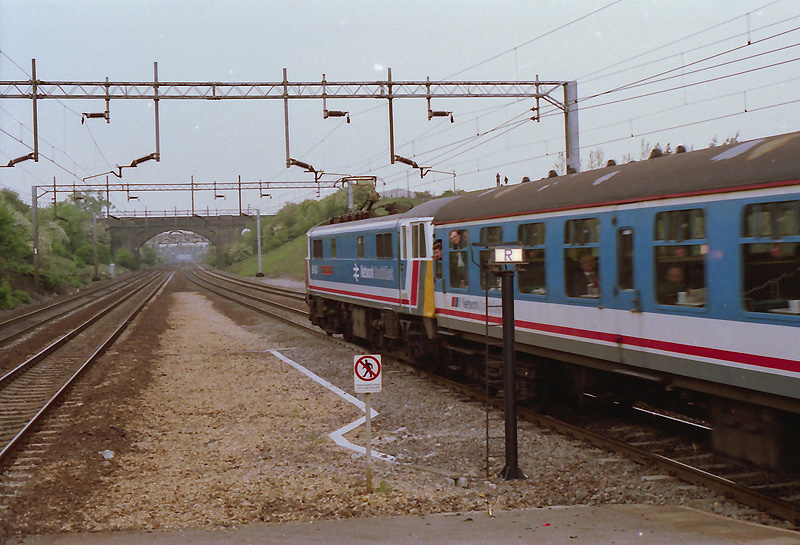
At Milton Keynes it was farewell to the NSE loco, the stock and the Cobblers. We waited for the 19:03, while our Wolverton colleague went one better, taking 86401 home before returning on a unit, armed with gen that a big siphon was out on the Marches.
A hurried check of the bible produced a workable, if late, route home. 85011 stormed down the Trent in the way only a roarer could, and a short wait brought 37221, carrying more bashers than we had seen all day. From Shrewsbury it was units home, including the legendary 00:15 Birmingham–Euston. So ended another chapter of modern railway history —
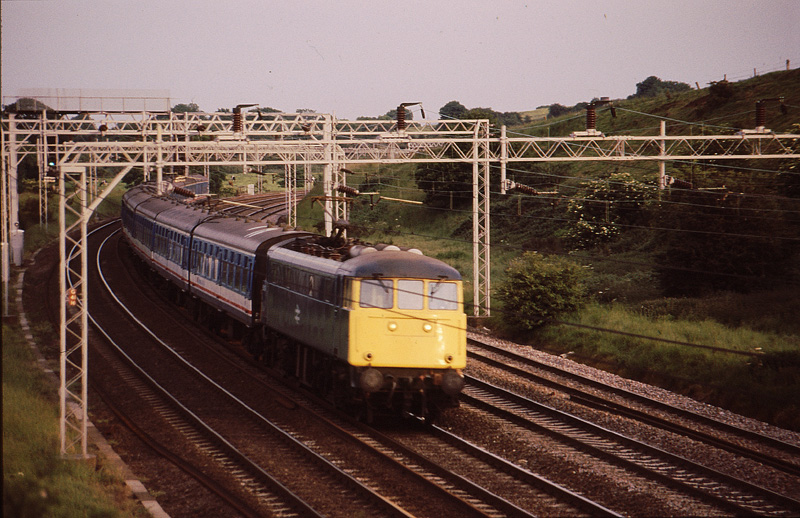
We end with another gem from the late Tony Ewer, 85009 takes an evening Cobbler North round the curves at Old Linslade on June 9th 1989..
end

